The Best POS System for Restaurants in Saudi Arabia (2026 Guide)

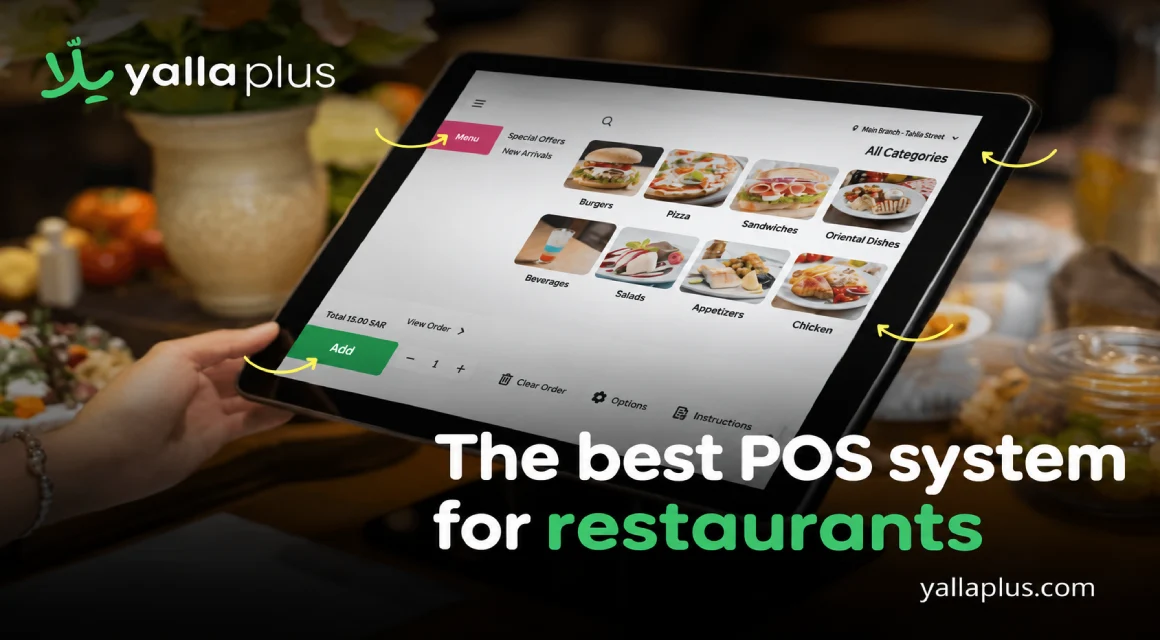
Running a restaurant in Saudi Arabia is hard enough without your checkout falling apart during the Friday dinner rush. Orders slip through the cracks between the floor and the kitchen, the receipts don't match the till, and then a ZATCA reminder about e-invoicing lands in your inbox and your stomach drops.
The right POS system for restaurants quietly handles all of that in the background, so you can focus on the food and the guests instead of the paperwork. But here's the catch: not every system that works fine in Dubai or Cairo is built for the Saudi market. Between VAT rules, Arabic receipts, and the delivery apps your customers actually use, you need one that speaks the local language, literally and legally.
Let's break down what a restaurant POS really does, what the Kingdom requires it to handle, and how to pick one that won't let you down when the dining room is packed.
What a POS system for restaurants actually does
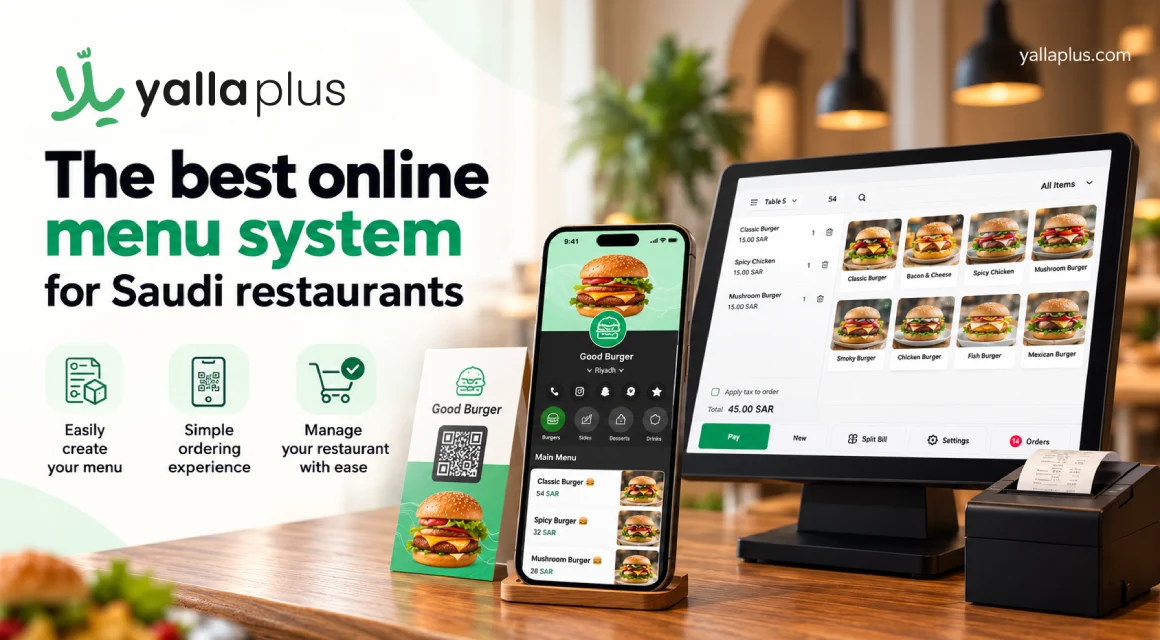
If you still picture a POS as a fancy cash register, you're underselling it by a mile. A modern restaurant POS is the nervous system of your whole operation, a full Point of Sale & Restaurant Management System that ties the front of house to the kitchen to your back-office numbers.
Here's what happens on a good one, all in a few taps. A waiter takes an order at the table, it fires straight to the kitchen screen, the ingredients get deducted from your inventory, the bill calculates VAT automatically, the guest pays by card or cash, and the sale lands in a report you can open from your phone that same night. No shouting across the pass, no handwritten dockets, no guessing why the cash drawer is short.
That's the difference between a till and a real restaurant pos. One rings up sales. The other runs the business.
Why the stakes are higher in Saudi Arabia
This is where a lot of restaurant owners get burned. A generic POS might look slick in a demo, but if it can't keep you compliant, it's a liability.
Saudi Arabia's tax authority, ZATCA, runs the Fatoorah e-invoicing program, and it's not optional. Every restaurant receipt is a simplified tax invoice, and it has to carry a QR code with your business name, VAT registration number, the timestamp, the total, and the VAT amount. Invoices need to be issued in Arabic, and VAT sits at 15%, calculated correctly on every single ticket. Phase 2 of Fatoorah also means your system has to be able to integrate with ZATCA's platform for reporting, not just print a pretty receipt.
Miss any of this and you're not looking at a minor inconvenience. You're looking at fines. So when you shop for a pos software for restaurants in the Kingdom, ZATCA compliance isn't a nice-to-have feature buried in the spec sheet. It's the first box you tick.
On top of the legal side, there's what your customers expect day to day. They pay with mada, Apple Pay, and cash. They order through Jahez, HungerStation, and ToYou. A POS that can't take those payments or pull in those delivery orders automatically leaves your staff copying tickets by hand, which is exactly how mistakes creep in on a busy night.
What to look for in a POS system for restaurants in Saudi Arabia
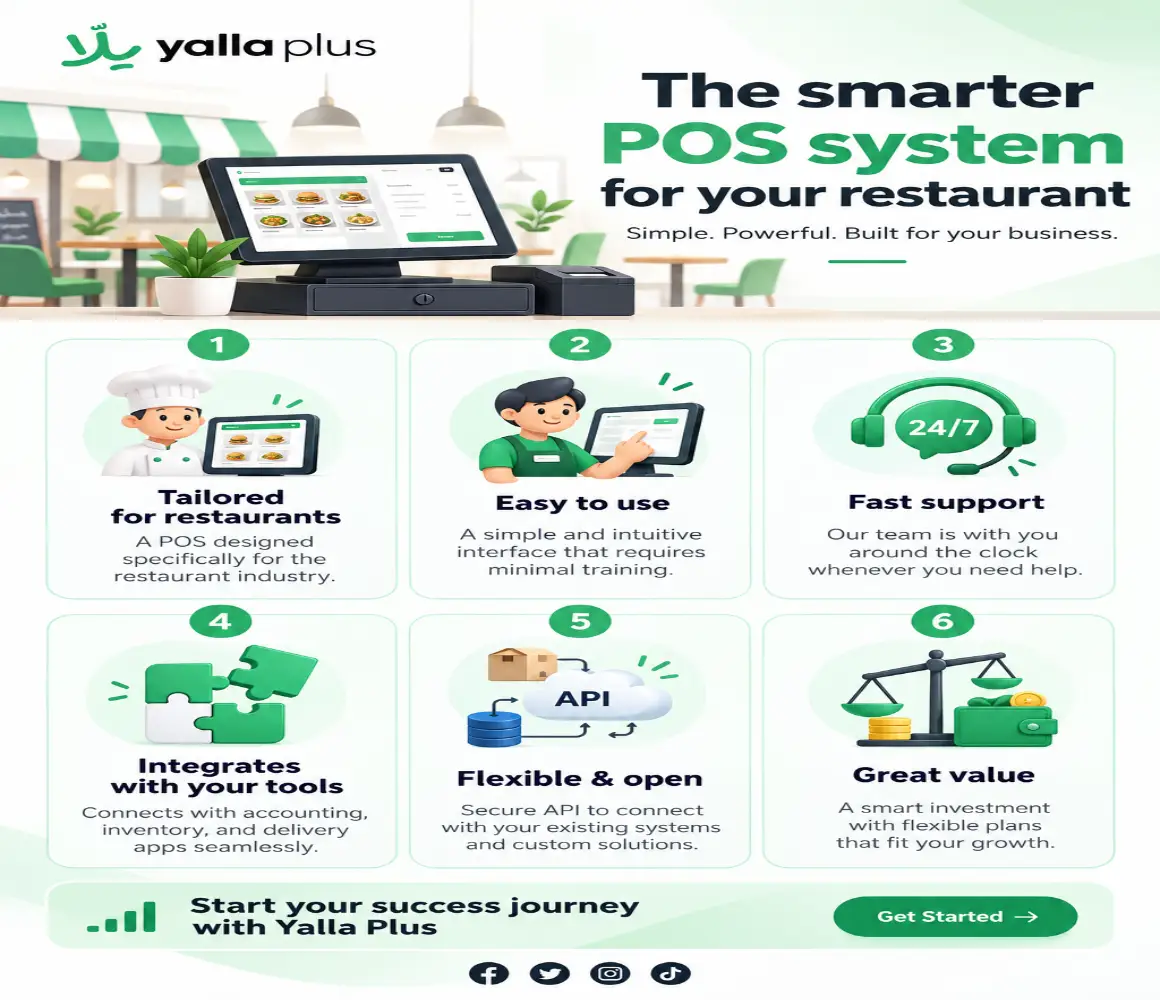
Once compliance is handled, the rest comes down to whether the system actually makes your team's life easier. Here's what separates a great pos system for restaurants in Saudi Arabia from one that just checks boxes.
Built-in ZATCA compliance. VAT, Arabic invoices, and QR codes should be automatic, not something you configure and pray over.
Full Arabic and English support. Your staff, your menu, and your receipts all need to work in both, cleanly, without garbled text.
Table and floor management. You want to see who's seated where, split bills without drama, and turn tables faster.
A kitchen display system. Orders go straight to the line on a screen, so nothing gets lost and the kitchen keeps its rhythm.
Inventory and food-cost tracking. Know what's running low before you run out, and see which dishes actually make you money.
Delivery app integration. Jahez, HungerStation, and the rest should flow into one screen instead of five separate tablets.
Works offline. The internet drops. Your ability to take orders shouldn't. A solid POS keeps running and syncs once you're back online.
Multi-branch reporting. If you have more than one location, or plan to, you want all of it in one dashboard.
It's actually easy to use. Your team turns over. New hires should be ringing in orders within an hour, not a week.
That last point matters more than people admit. The most powerful system in the world is useless if your staff fights it every shift.
Why yalla plus is the best POS system for restaurants in Saudi Arabia
This is exactly the gap yalla plus was built to close. It's a restaurant POS designed for the Saudi market from the ground up, not a foreign product with a VAT setting bolted on afterward.
ZATCA and Fatoorah compliance come standard, so your invoices carry the right QR codes and VAT is calculated correctly on every ticket without you thinking about it. The interface runs beautifully in Arabic and English, which means your team gets up to speed fast and your receipts look right to every customer.
Everything you'd expect from a serious pos system is there too, table management, a kitchen display, inventory that tells you what's running low, and reports you can check from your phone. It plays nicely with mada, Apple Pay, and cash, and it pulls your delivery orders from the major apps into one place so nobody's juggling tablets during the rush.
And because it keeps working when the connection drops, a slow internet day doesn't turn into a lost-sales day. That reliability is the quiet thing that separates a POS you tolerate from one you'd recommend to another owner.
What makes yalla plus stand out among Saudi Arabia's POS systems
Plenty of systems can take a payment. What puts yalla plus among the best POS systems in Saudi Arabia is that it was shaped around how restaurants here actually work, not adapted from somewhere else.
Three things make the difference. First, it's local by design: ZATCA compliance, Arabic-first receipts, mada and Apple Pay, and the delivery apps your customers already use are all handled natively, not patched in. Second, it's reliable when it counts, staying up during the dinner rush and through internet drops, which is exactly when a weaker system embarrasses you in front of a full room. Third, it grows with you, so a single café and a multi-branch group can run on the same platform without anyone outgrowing it or paying for firepower they don't need.
Add responsive local support that understands the market, and you get the real reason owners stick with it: it doesn't just work in a demo, it holds up on your busiest night.
is there difference between pos system for small or big restaurants?
Short answer: yes, if it's built to scale with you. A neighborhood café doesn't need the same firepower as a ten-branch group, but it shouldn't be forced onto software it'll outgrow in a year either.
If you're running a smaller spot, it's worth reading up specifically on choosing a cashier system for small restaurants before you commit, because the priorities shift a little when the budget's tighter and the menu's leaner. The good news is that starting small and growing into more branches, more staff, and more features shouldn't mean ripping everything out and starting over. Pick a system that grows with you and you only make this decision once.
The summary
The best POS system for restaurants in Saudi Arabia isn't the one with the longest feature list. It's the one that keeps you compliant with ZATCA, speaks Arabic and English fluently, handles your local payments and delivery apps, and stays out of your way so your team can do what they came to do, feed people well.
Frequently asked questions
How much does a POS system for restaurants cost in Saudi Arabia?
It depends on your setup, the number of branches, the features you need, and whether you're buying hardware or using tablets you already own. A single small café pays far less than a multi-branch group with kitchen screens and delivery integrations. The smarter question isn't just the monthly price, it's the total value: a system that prevents lost orders, keeps you ZATCA-compliant, and saves your staff time usually pays for itself fast. Ask for a quote based on your actual restaurant rather than a sticker price.
Does a restaurant POS have to be ZATCA compliant?
Yes, and there's no way around it. Under the Fatoorah e-invoicing program, every receipt you issue is a simplified tax invoice that needs a QR code, your VAT registration number, and correctly calculated 15% VAT, issued in Arabic. If your POS can't do this automatically, you're exposed to penalties. Compliance should be built in, not something you bolt on later.
Can a POS system work without an internet connection?
A good one can. Connections drop, especially during peak hours, and your ability to take orders and print receipts shouldn't drop with them. The right restaurant POS keeps running offline and syncs your sales data automatically once you're back online, so nothing gets lost.
What's the difference between a POS system and a cashier system?
People use the terms interchangeably, but there's a real gap. A cashier system mainly rings up sales and handles payments. A full POS system for restaurants adds table management, a kitchen display, inventory tracking, delivery-app integration, and reporting, tying your whole operation together. Smaller spots can start with something simpler and grow into the fuller feature set as they scale.
Does the POS support Arabic and English?
It should, fully and cleanly, not with patchy translations. Your staff need the interface in the language they're comfortable with, your menu has to display correctly in both, and your receipts must be in Arabic to meet ZATCA rules. Proper bilingual support isn't a bonus in this market; it's the baseline.
Can it connect to delivery apps like Jahez and HungerStation?
This is a big time-saver. Instead of your team juggling a separate tablet for each app and copying orders by hand, a well-integrated POS pulls delivery orders into the same screen as your dine-in tickets. Fewer devices, fewer mistakes, and a kitchen that isn't drowning in the evening rush.
.png)